English
  Български
  Deutsch
  العربية
  Čeština
  Dansk
Dansk  Ελληνικά
  Español
  Eesti
Eesti  Suomi
Suomi  Русский
  Türkçe
  Français
  Magyar
  Bahasa Indonesia
  Italiano
  日本語
日本語  한국어
한국어  Lietuvių
  Latviešu
  Norsk Bokmål
  Nederlands
  Polski
  Português
  Română
  Slovenčina
  Slovenščina
  Svenska
  Ukrainian
  中文
中文 
The Future of Real Estate: How Tokenization is Democratizing Property Investment


Introduction: The Exclusive World of Traditional Real Estate Investment
Real estate has long been considered one of the most reliable wealth-building vehicles in human history. From ancient landowners to modern property moguls, those who controlled real estate controlled wealth. The global real estate market represents approximately $280 trillion in value, making it the largest asset class in the world. Yet for the vast majority of people, meaningful participation in this wealth-generating machine has remained frustratingly out of reach.
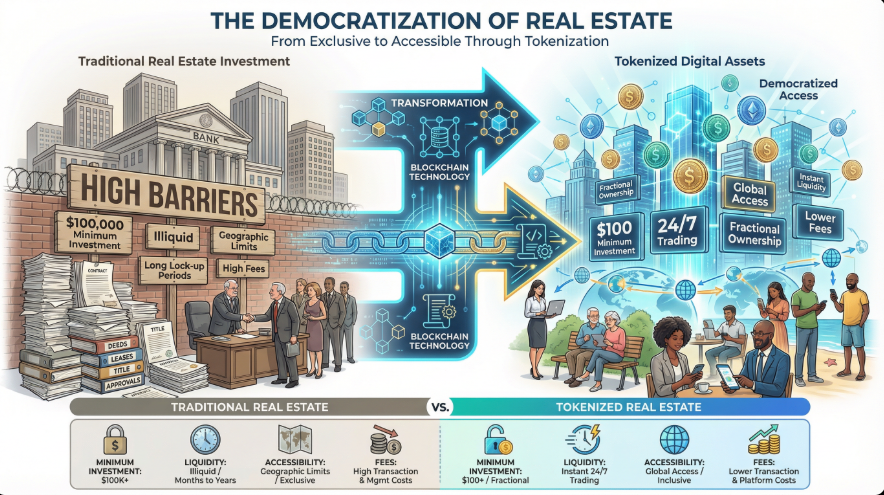
Traditional real estate investment operates behind high walls of exclusivity. Want to invest in a commercial office building in Manhattan? You will need at least $100,000 to $1 million just to get through the door. Interested in diversifying across multiple properties to reduce risk? Multiply that capital requirement by the number of properties. And once you finally manage to invest, your capital is locked up for years in an illiquid asset that cannot be easily sold when you need access to funds.
These barriers—high capital requirements, illiquidity, geographic limitations, and complex legal processes—have kept real estate investment the exclusive domain of the wealthy. The average investor watches from the sidelines as property values appreciate and rental income flows to those who had the capital to participate. This exclusivity has perpetuated wealth inequality, with real estate serving as a mechanism that concentrates wealth rather than distributes it.
But a technological revolution is dismantling these barriers. Blockchain technology and the tokenization of real assets are fundamentally transforming how real estate investment works, creating a future where anyone with as little as $100 can own a piece of premium commercial real estate, trade their holdings 24/7 on global markets, and build a diversified property portfolio that was previously accessible only to institutional investors and the ultra-wealthy.
This is not a distant vision—it is happening now. The real estate tokenization market has surpassed $10 billion in value as of 2025 and is projected to reach $4 trillion by 2035, representing a complete transformation of how property investment functions. Platforms like Slaff.io are at the forefront of this revolution, offering investors access to tokenized real estate funds that combine the wealth-building power of property investment with the accessibility and liquidity of digital assets.
This comprehensive guide explores how tokenization is democratizing real estate investment, the technology enabling this transformation, the benefits and risks for investors, and how you can participate in this historic shift in one of the world's largest asset classes.
The Problem: Why Traditional Real Estate Investment Excludes Most People
To understand the revolutionary nature of tokenization, we must first examine the fundamental problems that have made traditional real estate investment inaccessible to most people.
High Capital Requirements Create Insurmountable Barriers
The single largest barrier to real estate investment is the sheer amount of capital required to participate. Purchasing an investment property typically requires a down payment of 20% to 25% of the property value, plus closing costs, inspection fees, and legal expenses. For a modest $500,000 investment property, you need approximately $125,000 in cash just to get started. For commercial properties or premium residential real estate in major cities, the capital requirements can easily exceed $1 million.
Even alternative vehicles like Real Estate Investment Trusts (REITs) or real estate funds often have minimum investment thresholds of $25,000 to $100,000 for direct participation. While publicly traded REITs can be purchased in smaller amounts through stock markets, they offer limited control, high management fees, and exposure to market volatility that may not reflect the underlying property values.
These capital requirements effectively exclude the vast majority of potential investors. According to Federal Reserve data, the median household savings in the United States is approximately $5,300, and nearly 40% of Americans would struggle to cover an unexpected $400 expense. When the entry price for real estate investment is $25,000 to $100,000 or more, it is simply not an option for most people, regardless of their desire to participate or their understanding of real estate's wealth-building potential.
Illiquidity Traps Capital for Years
Real estate is notoriously illiquid. Unlike stocks or bonds that can be sold in seconds through online brokerages, selling real estate is a months-long process involving property preparation, marketing, showings, negotiations, inspections, financing contingencies, and legal paperwork. During market downturns, properties can sit unsold for years.
This illiquidity creates significant problems for investors. If you need access to capital for an emergency, an opportunity, or simply to rebalance your portfolio, you cannot quickly liquidate your real estate holdings. You are forced to either wait months to sell (often at a discount to attract buyers quickly) or take out loans against the property, incurring interest costs and additional risk.
The illiquidity of real estate also makes it difficult to respond to changing market conditions. If you believe a particular market is overvalued and due for a correction, you cannot simply exit your position. By the time you complete the sale process, the correction may have already occurred, locking in losses. This lack of flexibility is a fundamental disadvantage compared to liquid asset classes.
Geographic Limitations Restrict Diversification
Traditional real estate investment is inherently local. You invest in properties in your geographic area because you can physically inspect them, manage them, and respond to issues. This geographic concentration creates significant risk. If the local economy declines, if a major employer leaves the area, or if local regulations change unfavorably, your entire real estate portfolio suffers simultaneously.
Diversifying across multiple geographic markets requires exponentially more capital and management complexity. Owning investment properties in New York, Miami, Los Angeles, and Dallas means managing relationships with property managers, contractors, and tenants across four different markets, each with its own regulations and market dynamics. For most investors, this level of diversification is simply impractical.
International diversification is even more challenging. Investing in real estate in foreign countries involves navigating unfamiliar legal systems, currency exchange risk, foreign tax implications, and the logistical nightmare of managing properties thousands of miles away. As a result, most real estate investors remain concentrated in their local market, accepting geographic risk as an unavoidable reality.
Complex Legal Processes and High Transaction Costs
Real estate transactions are among the most complex and expensive in finance. Purchasing property involves title searches, property inspections, environmental assessments, legal reviews, mortgage applications, appraisals, and extensive paperwork. Each step requires specialized professionals—real estate agents, attorneys, inspectors, appraisers—who charge substantial fees.
Transaction costs typically range from 5% to 10% of the property value when buying and selling. For a $500,000 property, you might pay $25,000 to $50,000 in combined transaction costs over a full buy-sell cycle. These costs significantly erode returns, especially for shorter holding periods.
The complexity and cost of real estate transactions also create barriers to portfolio rebalancing. In a stock portfolio, you can easily adjust your allocations by selling overweighted positions and buying underweighted ones, with transaction costs of a few dollars per trade. In real estate, rebalancing means selling entire properties and buying new ones, incurring tens of thousands of dollars in costs and months of time. As a result, real estate portfolios tend to become static, unable to adapt to changing circumstances or opportunities.
Limited Fractional Ownership Options
While fractional ownership of real estate has existed in limited forms—such as timeshares, tenancy-in-common arrangements, and some private real estate funds—these options have their own significant limitations. Timeshares are notoriously difficult to resell and often come with high ongoing fees. Tenancy-in-common arrangements require finding co-investors, negotiating complex agreements, and managing relationships that can become contentious. Private real estate funds typically have high minimum investments, lock-up periods of five to ten years, and limited transparency about underlying assets.
None of these traditional fractional ownership models solve the fundamental problems of high capital requirements, illiquidity, and limited accessibility. They are workarounds that provide marginal improvements rather than transformative solutions.
The Solution: How Tokenization Democratizes Real Estate Investment
Blockchain technology and tokenization are solving all of these problems simultaneously, creating a fundamentally new model for real estate investment that is accessible, liquid, diversified, efficient, and transparent.
What Is Real Estate Tokenization?
Real estate tokenization is the process of converting ownership rights in a property into digital tokens on a blockchain. Each token represents a fractional ownership stake in the underlying real estate asset. These tokens can be bought, sold, and traded on digital platforms, providing liquidity and accessibility that traditional real estate investment cannot match.
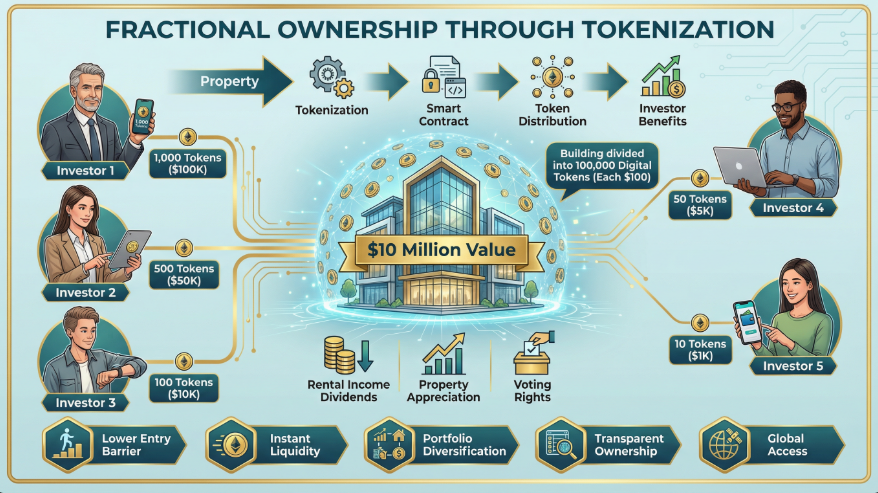
The process works as follows. A property owner or real estate fund creates a legal structure (typically a special purpose vehicle or LLC) that holds title to the property. Ownership shares in this legal entity are then represented as digital tokens on a blockchain. Investors purchase these tokens, giving them proportional ownership rights, including rights to rental income, property appreciation, and voting on major decisions.
The tokens are secured by smart contracts—self-executing code on the blockchain that automatically enforces the terms of ownership. When rental income is generated, the smart contract automatically distributes payments to token holders in proportion to their holdings. When a property is sold, the proceeds are automatically distributed. All transactions are recorded on the immutable blockchain ledger, providing complete transparency and eliminating disputes about ownership or payments.
Fractional Ownership: From $1 Million to $100

The most immediate and dramatic benefit of tokenization is the reduction in minimum investment requirements. A $10 million commercial property can be divided into 100,000 tokens of $100 each. Investors can purchase as few or as many tokens as they wish, allowing participation with as little as $100 instead of requiring millions in capital.
This fractional ownership model transforms the economics of real estate investment. A young professional with $5,000 to invest can now build a diversified portfolio of tokenized real estate across multiple properties and geographic markets, something that would have required $500,000 or more in traditional real estate investment. A retiree with $50,000 can allocate a portion to real estate without committing their entire savings to a single illiquid property.
The democratization is profound. According to market research, the tokenized real estate market grew from $2.81 billion in 2023 to over $10 billion in 2025, with projections reaching $11.80 billion by 2031 and potentially $4 trillion by 2035. This explosive growth is driven by millions of investors who were previously excluded from real estate investment gaining access for the first time.
Platforms like Slaff.io are pioneering this accessible model, offering tokenized real estate funds that allow investors to participate in professionally managed property portfolios with minimum investments far below traditional thresholds. This accessibility is not just about lowering barriers—it is about fundamentally changing who can build wealth through real estate.
24/7 Liquidity: Trading Real Estate Like Stocks
Tokenization solves the liquidity problem by creating secondary markets where tokens can be traded 24/7, similar to cryptocurrency exchanges. Instead of waiting months to sell a property, token holders can list their tokens for sale and potentially find buyers within minutes or hours. The transaction settles instantly through smart contracts, with ownership transferred and payment completed automatically.
This liquidity transformation has multiple benefits. Investors can access their capital when needed without the months-long sale process. They can respond to changing market conditions by adjusting their real estate holdings quickly. They can rebalance portfolios efficiently, selling overweighted positions and buying underweighted ones with minimal friction.
The liquidity also enables more sophisticated investment strategies. Investors can dollar-cost average into real estate positions over time, buying tokens gradually rather than committing large lump sums. They can take profits on appreciated holdings while maintaining exposure through remaining tokens. They can use technical analysis and market timing strategies that are impossible with traditional real estate's illiquidity.
It is important to note that liquidity depends on market depth—there must be buyers willing to purchase tokens at reasonable prices. In the early stages of tokenized real estate, some tokens may have limited liquidity, especially for smaller or less desirable properties. However, as the market matures and more investors participate, liquidity is expected to improve significantly, approaching the liquidity levels of publicly traded REITs while maintaining the benefits of direct property ownership.
Global Diversification Without Geographic Barriers
Tokenization eliminates geographic limitations entirely. An investor in Tokyo can purchase tokens representing ownership in a commercial building in New York, a residential complex in Berlin, and a retail center in Sydney, all through a single digital platform. The blockchain does not care about borders, and smart contracts execute identically regardless of the physical location of the underlying property.
This global accessibility enables true geographic diversification. Instead of concentrating risk in a single local market, investors can spread their real estate holdings across multiple countries, regions, and property types. If one market experiences a downturn, other markets may remain strong, reducing overall portfolio volatility.
The global nature of tokenized real estate also creates opportunities to capitalize on growth in emerging markets. An investor in a developed country can gain exposure to high-growth real estate markets in Asia, Africa, or Latin America without the logistical challenges of direct investment. This access to global opportunities was previously available only to large institutional investors with international operations.
Platforms like Slaff.io curate tokenized real estate opportunities from around the world, conducting due diligence and providing investors with access to vetted properties across multiple markets. This professional curation combined with the accessibility of tokenization creates unprecedented opportunities for global diversification.
Dramatically Lower Transaction Costs
Blockchain technology and smart contracts reduce transaction costs dramatically by eliminating many of the intermediaries required in traditional real estate transactions. There is no need for title companies, escrow agents, or extensive legal reviews for token transactions—the blockchain itself serves as the immutable record of ownership, and smart contracts handle the transfer automatically.
Transaction costs for buying and selling tokenized real estate typically range from 1% to 3% of the transaction value, compared to 5% to 10% for traditional real estate. This reduction in costs has a significant impact on returns, especially for investors who rebalance portfolios or trade more actively.
The lower costs also make smaller transactions economically viable. In traditional real estate, the fixed costs of transactions mean that buying a $10,000 stake in a property would be impractical—the transaction costs might exceed the investment itself. With tokenization, a $10,000 token purchase might incur $100 to $300 in costs, making small investments economically sensible.
Complete Transparency and Immutable Records
Every transaction in tokenized real estate is recorded on the blockchain, creating a permanent, transparent, and tamper-proof record of ownership and payments. Investors can independently verify their holdings, track rental income distributions, and review the complete transaction history of any property.
This transparency eliminates many of the trust issues that plague traditional real estate investment. In traditional real estate funds, investors must trust that the fund manager is accurately reporting property values, rental income, and expenses. In tokenized real estate, all financial data is recorded on the blockchain where it can be independently verified. Smart contracts automatically distribute rental income according to predetermined rules, eliminating the possibility of fund managers misallocating payments.
The immutable nature of blockchain records also provides strong legal protection. Ownership disputes, which can be costly and time-consuming in traditional real estate, become nearly impossible when ownership is recorded on a blockchain that cannot be altered retroactively. This certainty of ownership is particularly valuable in jurisdictions with less reliable legal systems or property registries.
The Market Opportunity: A $4 Trillion Transformation
The tokenization of real estate is not a niche trend—it is a fundamental transformation of one of the world's largest asset classes. The numbers tell the story of explosive growth and massive opportunity.
The global real estate market is valued at approximately $280 trillion, making it by far the largest asset class in the world. Yet the vast majority of this value remains locked in illiquid, inaccessible traditional ownership structures. Tokenization has the potential to unlock a significant portion of this value by making it accessible to global investors.
The tokenized real estate market has grown from $2.81 billion in 2023 to over $10 billion in 2025, representing a compound annual growth rate of over 100%. Industry projections estimate the market will reach $11.80 billion by 2031 at a more sustainable 19.9% CAGR, and potentially $4 trillion by 2035 according to Deloitte estimates. McKinsey projects that the broader real-world asset (RWA) tokenization market, of which real estate is the largest component, could reach $2 trillion by 2030.
These projections are supported by increasing regulatory clarity, technological maturation, and growing investor awareness. In 2025, multiple jurisdictions implemented clear regulatory frameworks for tokenized securities, providing the legal certainty necessary for institutional adoption. Major financial institutions, including banks and asset managers, have begun offering tokenized real estate products to their clients, lending credibility and infrastructure to the market.
The growth is also driven by demographic shifts. Younger investors, particularly millennials and Gen Z, are digital natives comfortable with cryptocurrency and blockchain technology. They view tokenized assets as a natural evolution of investing and are more likely to adopt tokenized real estate than older generations. As this demographic cohort accumulates wealth, their preference for digital, accessible investment vehicles will accelerate tokenization adoption.
For early adopters, this growth trajectory represents significant opportunity. Investors who participate in tokenized real estate now are positioning themselves at the beginning of a multi-trillion-dollar market transformation. Platforms like Slaff.io that are building the infrastructure and curating high-quality tokenized real estate opportunities are likely to capture substantial value as the market matures.
Real-World Applications: How Tokenized Real Estate Works in Practice
To make tokenization concrete, let us examine how it works in practice through realistic examples.
Example 1: Commercial Office Building Tokenization
A real estate developer owns a 20-story commercial office building in a major city center, valued at $50 million. The building generates $3 million in annual net rental income, representing a 6% yield. Traditionally, the developer would either hold the property directly or sell it to an institutional investor or REIT.
Instead, the developer decides to tokenize the property. They create a special purpose vehicle (SPV) that holds title to the building and issue 500,000 tokens at $100 each, representing fractional ownership in the SPV. Each token entitles the holder to a proportional share of rental income and property appreciation.
An investor purchases 1,000 tokens for $100,000, representing 0.2% ownership of the building. Each year, the investor receives $6,000 in rental income distributions (0.2% of $3 million), paid automatically through smart contracts in monthly installments of $500. If the property appreciates to $60 million over five years, the investor's 1,000 tokens are now worth $120,000, representing a $20,000 capital gain plus $30,000 in cumulative rental income.
Critically, the investor can sell their tokens at any time on a secondary market. If they need liquidity after two years, they can list their tokens for sale and potentially find buyers within days or hours, receiving payment instantly through smart contract execution. This liquidity is impossible with traditional real estate ownership.
Example 2: Diversified Real Estate Fund on Slaff.io
Slaff.io offers a tokenized real estate fund that holds a diversified portfolio of properties across multiple markets and property types. The fund includes commercial office buildings, residential apartment complexes, retail centers, and industrial warehouses in North America, Europe, and Asia.
An investor purchases $10,000 worth of fund tokens. Through this single investment, they gain fractional ownership in dozens of properties across multiple continents, achieving a level of diversification that would require millions of dollars in traditional real estate investment. The fund is professionally managed, with property selection, tenant management, and maintenance handled by experienced real estate professionals.
The investor receives quarterly distributions of rental income, automatically calculated and paid through smart contracts. They can monitor the fund's performance, view detailed information about underlying properties, and track their token value in real-time through the Slaff.io platform. If they decide to exit the investment, they can sell their tokens on the platform's secondary market, with settlement occurring instantly.
This model combines the accessibility and liquidity of tokenization with professional management and diversification, creating an investment vehicle that is superior to both traditional direct real estate ownership and traditional REITs.
Example 3: International Property Access
An investor in Germany wants exposure to the rapidly growing real estate market in Southeast Asia but lacks the local knowledge and connections to invest directly. Through a tokenized real estate platform, they discover a tokenized luxury residential development in Singapore.
They purchase $5,000 worth of tokens representing fractional ownership in the development. The smart contract automatically handles currency conversion, and the investor now owns a piece of Singapore real estate without ever visiting the country, navigating Singapore's legal system, or dealing with local property management.
As the Singapore real estate market appreciates and the development generates rental income, the investor benefits proportionally. They receive rental distributions in their local currency, automatically converted by the smart contract. If they decide to sell, they can list their tokens on the platform and find buyers from anywhere in the world, with the transaction settling instantly.
This example illustrates how tokenization eliminates geographic barriers entirely, enabling truly global real estate investment for individual investors.
Benefits for Different Types of Investors
Tokenized real estate offers distinct benefits for different investor profiles.
For New Investors: Accessibility and Education
New investors with limited capital can begin building real estate exposure with small investments, learning about property markets and investment dynamics without risking large sums. The ability to invest $100 or $1,000 instead of $100,000 makes real estate accessible as an educational opportunity, allowing new investors to gain experience before committing larger amounts.
The transparency of blockchain-based platforms also provides educational value. New investors can see exactly how rental income is generated and distributed, how property values change over time, and how different property types and markets perform. This visibility accelerates learning and builds confidence.
For Experienced Investors: Diversification and Liquidity
Experienced real estate investors can use tokenization to diversify beyond their existing holdings without the capital requirements and management burden of purchasing additional physical properties. They can gain exposure to property types or geographic markets they could not access traditionally, improving portfolio risk-adjusted returns.
The liquidity of tokenized real estate also allows experienced investors to be more tactical, adjusting their real estate allocations based on market conditions rather than being locked into illiquid positions for years. This flexibility is particularly valuable during market transitions.
For International Investors: Global Access
Investors outside major real estate markets can access premium properties in global financial centers that would otherwise be completely inaccessible. An investor in a developing country can build a portfolio of real estate in New York, London, and Tokyo, gaining exposure to stable, appreciating markets and diversifying away from their local economy.
The ability to invest in hard currency assets (properties in the US, Europe, etc.) also provides a hedge against local currency depreciation, a significant concern for investors in countries with unstable currencies.
For Retirees: Income Generation
Retirees seeking stable income can allocate a portion of their portfolio to tokenized real estate funds that generate consistent rental income distributions. The automatic distribution through smart contracts provides reliable cash flow without the management burden of directly owning rental properties.
The liquidity of tokenized real estate also addresses a key concern for retirees—the ability to access capital if unexpected expenses arise. Unlike traditional real estate that might take months to sell, tokenized holdings can be liquidated quickly if needed.
Risks and Considerations: A Balanced Perspective
While tokenized real estate offers transformative benefits, it is essential to understand the risks and limitations.
Regulatory Uncertainty
The regulatory framework for tokenized securities is still evolving. Different jurisdictions have different rules about how tokenized real estate can be offered, who can invest, and what disclosures are required. Regulatory changes could impact the liquidity, transferability, or tax treatment of tokenized real estate holdings.
Investors should ensure they are using platforms that operate in compliance with applicable securities laws and that provide clear information about the legal structure of tokenized offerings. Platforms like Slaff.io that prioritize regulatory compliance and work within established legal frameworks provide greater security than platforms operating in regulatory gray areas.
Market Liquidity Risk
While tokenization enables secondary market trading, liquidity depends on there being buyers willing to purchase tokens at reasonable prices. In the early stages of market development, some tokenized properties may have limited trading volume, making it difficult to sell large positions quickly without accepting discounted prices.
As the tokenized real estate market matures and more investors participate, liquidity is expected to improve. However, investors should not assume that tokenized real estate will always be as liquid as major stocks or cryptocurrencies, especially during market stress.
Technology Risk
Tokenized real estate depends on blockchain technology, smart contracts, and digital platforms functioning correctly. While blockchain technology is generally robust, there are risks of software bugs, smart contract vulnerabilities, or platform failures that could impact investors.
Reputable platforms conduct extensive security audits of their smart contracts and implement multiple layers of security to protect investor assets. Investors should prioritize platforms with strong security track records and transparent security practices.
Property-Specific Risks
Tokenization does not eliminate the fundamental risks of real estate investment—property values can decline, tenants can default, properties can require expensive repairs, and local market conditions can deteriorate. Investors in tokenized real estate are still exposed to these property-specific risks.
Diversification across multiple properties and markets is the primary mitigation strategy. Investing in tokenized real estate funds that hold diversified portfolios reduces exposure to any single property's risks.
Valuation and Transparency
While blockchain provides transparency about ownership and transactions, the valuation of underlying properties still depends on traditional appraisal methods. There is a risk that properties may be overvalued at the time of tokenization, or that valuations may not be updated frequently enough to reflect changing market conditions.
Investors should review the valuation methodology used by tokenization platforms and ensure that properties are appraised by independent, qualified professionals. Platforms that provide regular updated valuations and transparent disclosure of valuation methods offer better protection.
How to Get Started with Tokenized Real Estate Investment
For investors ready to participate in tokenized real estate, the process is straightforward.
Step 1: Choose a Reputable Platform
Select a tokenized real estate platform that operates in compliance with securities regulations, has a track record of successful offerings, provides transparent information about properties and fees, and implements strong security measures. Slaff.io is a leading platform offering tokenized real estate funds with professional management, regulatory compliance, and a user-friendly interface.
Step 2: Complete Identity Verification
Most tokenized real estate platforms require identity verification (KYC - Know Your Customer) to comply with securities regulations and anti-money laundering laws. This typically involves providing identification documents and proof of address. The verification process usually takes a few days.
Step 3: Fund Your Account
Once verified, you can fund your account through various methods, including bank transfer, credit card, or cryptocurrency. Different platforms support different funding methods, so review the options available.
Step 4: Research Investment Opportunities
Review the available tokenized real estate offerings on the platform. Examine property details, location, rental income history, projected returns, fees, and the legal structure of the offering. Many platforms provide detailed property reports, financial projections, and risk disclosures.
For new investors, starting with diversified real estate funds rather than individual properties provides better risk management through diversification.
Step 5: Make Your Investment
Once you have identified an opportunity that fits your investment goals and risk tolerance, you can purchase tokens directly through the platform. Specify the amount you want to invest, review the transaction details, and confirm the purchase. The tokens will be credited to your account, and you will begin receiving rental income distributions according to the property's payment schedule.
Step 6: Monitor and Manage Your Investment
Use the platform's dashboard to monitor your investment performance, track rental income distributions, and review property updates. Most platforms provide detailed reporting and performance analytics.
If you decide to exit your investment, you can list your tokens for sale on the platform's secondary market. Specify your asking price and wait for a buyer, or accept current market offers for immediate liquidity.
The Future: Where Tokenized Real Estate Is Heading
The tokenization of real estate is still in its early stages, with significant growth and innovation ahead.
In the near term (2026-2028), we can expect continued regulatory clarity as more jurisdictions implement clear frameworks for tokenized securities. This regulatory maturation will enable larger institutional investors to participate, bringing substantial capital and liquidity to the market. Major financial institutions will likely launch their own tokenized real estate products, integrating them into traditional wealth management offerings.
Technology will continue to improve, with more sophisticated smart contracts enabling complex ownership structures, automated property management, and integration with other blockchain-based financial services. Interoperability between different blockchain platforms will improve, allowing tokens to be traded across multiple exchanges and platforms, further enhancing liquidity.
In the medium term (2029-2032), tokenized real estate may become a standard component of diversified investment portfolios, recommended by financial advisors alongside stocks, bonds, and traditional real estate. The secondary market for tokenized real estate will mature, with dedicated exchanges providing deep liquidity and price discovery. Tokenized real estate may even be used as collateral for loans, enabling investors to access liquidity without selling their holdings.
In the long term (2033+), the distinction between "tokenized" and "traditional" real estate may disappear as tokenization becomes the default method of property ownership and transfer. Property titles may be recorded on blockchain by default, with tokens representing legal ownership recognized by governments and courts worldwide. The entire $280 trillion global real estate market could operate on blockchain infrastructure, with instant settlement, complete transparency, and global accessibility as standard features.
Platforms like Slaff.io that are building the infrastructure for this future today are positioning themselves as the leaders of the tokenized real estate industry. For investors, participating now means being part of this transformation from the beginning, with the potential for substantial returns as the market grows from billions to trillions.
Conclusion: The Democratization of Wealth Building
The tokenization of real estate represents one of the most significant democratization events in financial history. For centuries, real estate investment has been the exclusive domain of the wealthy, a powerful wealth-building tool accessible only to those with substantial capital. Tokenization is changing this fundamental reality, making property investment accessible to anyone with an internet connection and a modest amount of capital.
This democratization has profound implications. When millions of people who were previously excluded from real estate investment gain access, wealth-building opportunities become more evenly distributed. The concentration of wealth in the hands of property owners begins to broaden. The next generation of wealth is built not just by those who inherited capital or achieved exceptional success, but by ordinary people who consistently invested modest amounts in tokenized real estate over time.
The technology enabling this transformation—blockchain, smart contracts, and digital tokens—is mature and proven. The regulatory frameworks are developing rapidly. The market infrastructure is being built by innovative platforms like Slaff.io. The growth trajectory is clear, with projections of a $4 trillion market by 2035.
For investors, the question is not whether tokenized real estate will transform the industry—it is whether you will participate in this transformation early, positioning yourself to benefit as the market grows, or wait until tokenization is mainstream and the early-mover advantages have been captured by others.
The future of real estate is tokenized, accessible, liquid, and global. The future is being built now. The opportunity to participate is available today.
Frequently Asked Questions (FAQ)
1. Is tokenized real estate a security, and is it regulated?
Yes, in most jurisdictions, tokenized real estate is classified as a security because it represents an investment contract with an expectation of profit derived from the efforts of others. This means tokenized real estate offerings must comply with securities regulations, including registration requirements, investor accreditation rules, and disclosure obligations. Reputable platforms like Slaff.io operate in full compliance with applicable securities laws, ensuring that offerings are properly structured and that investors receive appropriate disclosures and protections. Always verify that any tokenized real estate platform you use is operating legally in your jurisdiction.
2. How do I receive rental income from tokenized real estate?
Rental income from tokenized real estate is typically distributed automatically through smart contracts. The property or fund generates rental income from tenants, which is collected by the property manager or fund administrator. After deducting operating expenses and management fees, the net rental income is distributed to token holders in proportion to their ownership percentage. The smart contract automatically calculates each token holder's share and transfers the payment to their wallet or account. Distributions are usually made monthly or quarterly, depending on the specific offering. You can track your income distributions through the platform's dashboard.
3. What happens if the property needs major repairs or renovations?
Major repairs or renovations are typically funded through reserves set aside from rental income or through additional capital calls to token holders. The specific mechanism depends on the legal structure of the tokenized offering. In some structures, token holders vote on major expenditures, with decisions made by majority or supermajority vote. In fund structures, the fund manager makes these decisions within the parameters disclosed in the offering documents. Before investing, review the offering documents to understand how major expenditures are handled and whether you could be required to contribute additional capital. Well-managed properties and funds maintain adequate reserves to handle routine maintenance and repairs without requiring additional capital from investors.
4. Can I lose money investing in tokenized real estate?
Yes, like any investment, tokenized real estate carries risk and you can lose money. Property values can decline due to market conditions, economic downturns, or property-specific issues. Rental income can decrease if tenants vacate or default. Operating expenses can increase unexpectedly. The tokens themselves may decline in value on secondary markets, especially during periods of market stress or if liquidity is limited. Additionally, there are technology risks, regulatory risks, and platform risks specific to tokenized investments. To manage these risks, diversify across multiple properties and markets, invest only amounts you can afford to lose, conduct thorough due diligence on properties and platforms, and maintain a long-term investment horizon. Tokenized real estate should be one component of a diversified investment portfolio, not your entire portfolio.
5. How is tokenized real estate taxed?
The tax treatment of tokenized real estate varies by jurisdiction and depends on the specific legal structure of the offering. In general, rental income distributions are typically taxed as ordinary income in the year received. Capital gains from selling tokens are usually taxed as capital gains, with the rate depending on how long you held the tokens (short-term vs. long-term). Some tokenized real estate structures may allow for depreciation deductions or other tax benefits similar to traditional real estate investment. However, the tax treatment of tokenized assets is still evolving, and regulations may change. Consult with a tax professional familiar with both real estate and cryptocurrency/tokenized asset taxation in your jurisdiction to understand your specific tax obligations. Reputable platforms like Slaff.io provide tax documentation to help investors report their income and gains accurately.
IMPORTANT DISCLAIMER
Not Financial Advice: This article is provided for informational and educational purposes only and does not constitute financial, investment, legal, or tax advice. The content is based on publicly available information and industry research and should not be relied upon as the sole basis for making investment decisions.
Investment Risks: All investments carry risk, including the potential loss of principal. Tokenized real estate investments involve specific risks including but not limited to: market volatility, liquidity risk, regulatory uncertainty, technology risks, property-specific risks, and the potential for total loss of investment. Past performance is not indicative of future results.
Consult Professionals: Before making any investment decision, you should consult with qualified financial, legal, and tax advisors who understand your specific circumstances, risk tolerance, and investment objectives. This is particularly important for tokenized assets and blockchain-based investments, which may have complex legal and tax implications.
No Guarantees: No representation or warranty is made concerning the accuracy, completeness, or timeliness of the information provided. Market conditions, regulations, and technology are subject to change. Projected returns, market size estimates, and growth forecasts are based on third-party research and should not be considered guaranteed outcomes.
Platform-Specific Information: References to Slaff.io or any other platform are for illustrative purposes. Investors should conduct their own due diligence on any platform before investing, including reviewing offering documents, understanding fee structures, and verifying regulatory compliance in their jurisdiction.
Regulatory Compliance: Tokenized securities may be subject to securities regulations in your jurisdiction. Ensure you understand and comply with all applicable laws, including investor accreditation requirements, if any.
Independent Research: This article should be considered one source of information among many. Conduct thorough independent research before making investment decisions.