English
  Български
  Deutsch
  العربية
  Čeština
  Dansk
Dansk  Ελληνικά
  Español
  Eesti
Eesti  Suomi
Suomi  Русский
  Türkçe
  Français
  Magyar
  Bahasa Indonesia
  Italiano
  日本語
日本語  한국어
한국어  Lietuvių
  Latviešu
  Norsk Bokmål
  Nederlands
  Polski
  Português
  Română
  Slovenčina
  Slovenščina
  Svenska
  Ukrainian
  中文
中文  Srpski
  Hrvatski
Slaff.io vs Traditional Real Estate Investing: Complete 2026 Guide


Slaff.io vs Traditional Real Estate Investing: Complete 2026 Guide
Introduction: Two Worlds of Real Estate Investment
Real estate has long been recognized as one of the most reliable paths to wealth building, offering both consistent income through rental payments and long-term appreciation as property values rise. However, the traditional approach to real estate investment—purchasing physical properties directly or investing through conventional Real Estate Investment Trusts (REITs)—comes with significant barriers, limitations, and inefficiencies that have kept this wealth-building opportunity out of reach for most people.
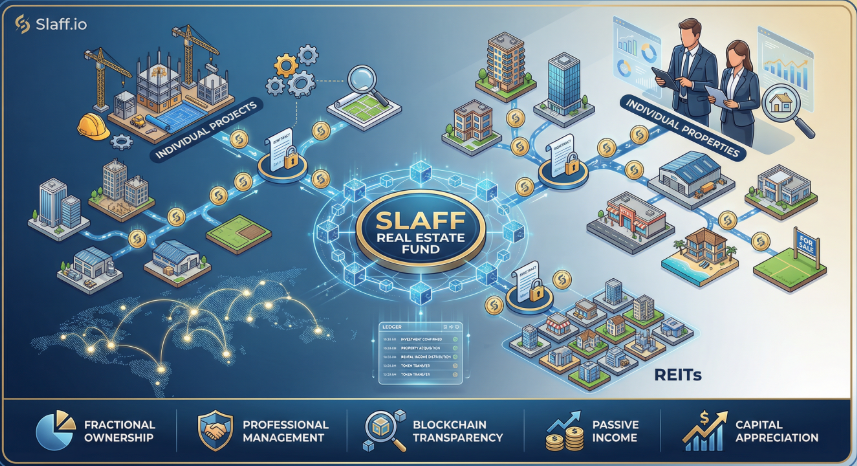
Slaff.io represents a fundamentally different approach to real estate investment, leveraging blockchain technology and asset tokenization to eliminate the barriers and inefficiencies of traditional real estate while preserving and enhancing the wealth-building benefits. The platform offers fractional ownership in professionally selected properties, instant liquidity through 24/7 trading, complete transparency via blockchain ledgers, and accessibility with minimum investments starting at just $100.
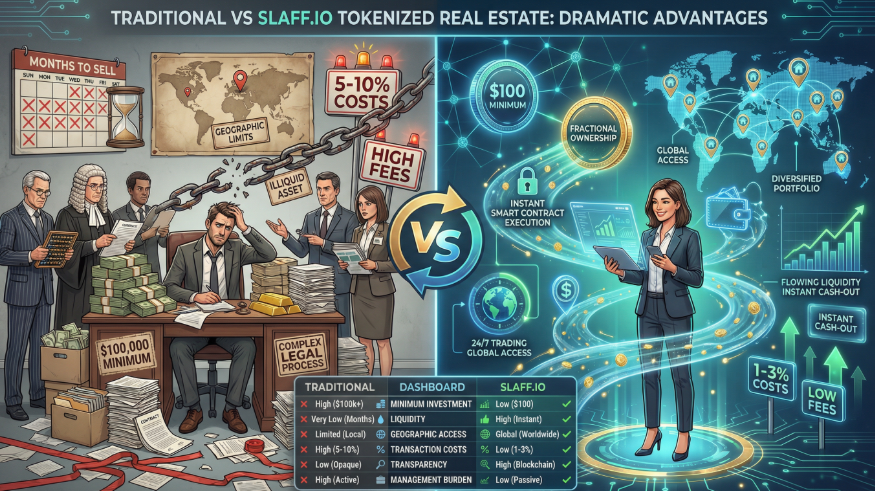
But how does Slaff.io's tokenized approach actually compare to traditional real estate investment when examined rigorously across every relevant dimension? Is tokenization merely a technological novelty, or does it represent a genuine improvement that delivers superior outcomes for investors? This comprehensive head-to-head comparison examines ten critical dimensions of real estate investment—minimum capital requirements, liquidity, diversification potential, geographic access, transaction costs, transparency, management burden, income distribution, ownership verification, and overall accessibility—providing a definitive analysis of how these two approaches stack up against each other.
For investors evaluating whether to pursue traditional real estate investment or embrace the tokenized future that Slaff.io offers, this comparison provides the detailed, objective analysis needed to make an informed decision. The conclusion, as we will demonstrate, is clear: across virtually every dimension that matters to investors, Slaff.io's tokenized approach delivers superior outcomes.
Dimension 1: Minimum Investment Requirements

Perhaps the most immediately obvious difference between traditional and tokenized real estate is the minimum capital required to participate.
Traditional Real Estate: The $100,000+ Barrier
Traditional real estate investment requires substantial capital. Purchasing an investment property directly typically requires a down payment of 20% to 25% of the property value, plus closing costs, inspections, and reserves. For a modest $500,000 investment property, you need approximately $125,000 to $150,000 in cash to complete the purchase.
Even if you want to invest in real estate without the burden of direct property ownership, the alternatives still require significant capital. Private real estate funds typically have minimum investments of $25,000 to $100,000. Publicly traded REITs can be purchased for the price of a single share (often $50 to $200), but building a meaningful position that generates substantial income requires investing thousands of dollars.
These capital requirements create an insurmountable barrier for the vast majority of potential investors. According to Federal Reserve data, the median household savings in the United States is approximately $5,300. When the entry price for real estate investment is $25,000 to $150,000, it is simply not an option for most people, regardless of their desire to participate or their understanding of real estate's wealth-building potential.
This high capital requirement also creates concentration risk. If you have $150,000 to invest and you use it all to purchase a single property, your entire real estate portfolio consists of one asset in one location. Any property-specific problem—a bad tenant, unexpected repairs, local market decline—affects 100% of your real estate holdings. Diversification requires even more capital, multiplying the $150,000 requirement by the number of properties you want to own.
Slaff.io: The $100 Entry Point
Slaff.io eliminates the capital barrier entirely through fractional tokenization. Properties are divided into digital tokens, each representing a small ownership stake. Minimum investments typically range from $100 to $1,000 depending on the specific offering, making real estate investment accessible to virtually anyone with modest savings.
This 100x to 1,000x reduction in minimum investment is not merely incremental improvement—it is transformative democratization. A young professional with $5,000 to invest can now build a diversified real estate portfolio across multiple properties and markets, something that would have required $500,000 or more in traditional real estate. A student with $500 can begin building real estate exposure and learning about property investment, gaining experience that would have been impossible without substantial wealth.
The low minimum also enables dollar-cost averaging strategies. Instead of saving for years to accumulate $100,000 for a single property purchase, investors can invest $500 or $1,000 monthly into tokenized real estate, gradually building a position over time. This regular investment approach reduces timing risk and allows investors to benefit from market fluctuations.
Winner: Slaff.io — The ability to invest with $100 instead of $100,000+ represents a 1,000x improvement in accessibility, democratizing real estate investment in a way that traditional approaches never could.
Dimension 2: Liquidity and Exit Flexibility
Liquidity—the ability to convert an investment back into cash quickly without significant loss of value—is one of the most critical differences between traditional and tokenized real estate.
Traditional Real Estate: Months to Years
Traditional real estate is notoriously illiquid. Selling a property is a months-long process involving property preparation, professional photography, listing and marketing, showings and open houses, negotiations with potential buyers, inspections and appraisals, financing contingencies, and legal closing procedures. Even in strong markets, this process typically takes three to six months. In weak markets or for properties with limited appeal, selling can take a year or more.
This illiquidity creates multiple problems for investors. If you need access to capital for an emergency, an opportunity, or simply to rebalance your portfolio, you cannot quickly liquidate your real estate holdings. You are forced to either wait months to sell (often at a discount to attract buyers quickly) or take out loans against the property, incurring interest costs and additional risk.
The illiquidity also makes it impossible to respond tactically to changing market conditions. If you believe a particular market is overvalued and due for a correction, you cannot simply exit your position. By the time you complete the sale process months later, the correction may have already occurred, locking in losses.
Traditional REITs offer better liquidity than direct property ownership—shares can be sold on stock exchanges during market hours. However, REIT share prices can be volatile and may not reflect the underlying property values, especially during market stress. You also face the standard stock market limitation of trading only during business hours on weekdays.
Slaff.io: 24/7 Instant Trading
Slaff.io transforms real estate liquidity through tokenization and secondary market trading. Token holders can list their tokens for sale on the platform's marketplace at any time, and potential buyers can purchase them instantly through smart contract execution. The transaction settles in minutes or hours rather than months, with ownership transferred and payment completed automatically.
The secondary market operates 24/7, unlike stock exchanges that close nights and weekends. You can sell your tokenized real estate holdings at 2 AM on a Sunday if you choose, providing flexibility that no traditional investment vehicle can match.
This liquidity transformation has profound implications. Real estate shifts from being a locked-up, illiquid investment to a flexible asset that investors can adjust as their circumstances or market views change. You can take profits on appreciated holdings while maintaining exposure through remaining tokens. You can exit positions that no longer fit your strategy and redeploy capital to better opportunities. You can access your capital when needed without the months-long sale process or the costs of property loans.
It is important to note that liquidity depends on market depth—there must be buyers willing to purchase tokens at reasonable prices. In the early stages of tokenized real estate, some tokens may have limited liquidity, especially for smaller or less desirable properties. However, as the market matures and more investors participate, liquidity continues improving. Even with limited liquidity, tokenized real estate is dramatically more liquid than traditional property ownership.
Winner: Slaff.io — The ability to sell real estate holdings in hours instead of months, 24/7 instead of business hours only, represents a fundamental improvement in investment flexibility and risk management.
Dimension 3: Diversification Potential
Diversification—spreading investments across multiple assets to reduce risk—is a fundamental principle of sound investing. The ability to diversify effectively differs dramatically between traditional and tokenized real estate.
Traditional Real Estate: Limited by Capital
Diversification in traditional real estate requires owning multiple properties, which multiplies the already-high capital requirements. If a single property requires $150,000, owning three properties for basic diversification requires $450,000. Owning ten properties for meaningful diversification across property types and markets requires $1.5 million.
This capital requirement means that most traditional real estate investors own one, two, or at most three properties. Their real estate portfolio is highly concentrated, exposed to property-specific risks (bad tenants, unexpected repairs, local regulations) and geographic risks (local economic decline, natural disasters, market-specific downturns).
Even investors who can afford multiple properties face practical limitations. Managing multiple properties across different markets requires coordinating with multiple property managers, contractors, and service providers. The complexity and time burden increase with each additional property, creating practical limits on diversification even for wealthy investors.
Traditional REITs offer better diversification than direct ownership, as a single REIT may hold dozens or hundreds of properties. However, you have no control over which properties are in the portfolio or how they are managed. You also typically invest in a single REIT, which may focus on a specific property type (office, residential, retail) or geographic market, limiting true diversification.
Slaff.io: Dozens of Properties with Modest Capital
Slaff.io enables true diversification with modest capital through fractional ownership. An investor with $10,000 can build a portfolio spanning dozens of properties across multiple property types (industrial, residential, office, vacation, retail, land) and multiple geographic markets (different cities, regions, or countries).
This diversification dramatically reduces risk. If one property underperforms due to local market conditions or property-specific issues, it represents only a small percentage of your total real estate holdings. The other properties continue generating income and appreciation, insulating your overall returns from any single property's problems.
The platform's REIT offerings provide instant diversification through professionally managed portfolios. A single investment in a Slaff.io REIT provides exposure to a curated collection of properties across all six property categories and multiple markets, achieving diversification that would require millions of dollars in traditional real estate.
The diversification is also dynamic—you can easily adjust your portfolio allocation over time. If you believe residential real estate will outperform commercial in the coming years, you can sell some commercial property tokens and purchase more residential tokens. This tactical rebalancing is simple and low-cost with tokenized real estate, but prohibitively expensive and time-consuming with traditional properties.
Winner: Slaff.io — The ability to achieve meaningful diversification across dozens of properties and multiple markets with $10,000 instead of $1.5 million represents a 150x improvement in risk management capability.
Dimension 4: Geographic Access and Global Reach

The ability to invest in properties across different geographic markets provides both diversification benefits and access to high-growth opportunities.
Traditional Real Estate: Local or National at Best
Traditional real estate investment is inherently local. You invest in properties in your geographic area because you can physically inspect them, manage them, and respond to issues. This geographic concentration creates significant risk—if the local economy declines, if a major employer leaves the area, or if local regulations change unfavorably, your entire real estate portfolio suffers simultaneously.
Diversifying across multiple geographic markets requires exponentially more capital and management complexity. Owning investment properties in New York, Miami, Los Angeles, and Dallas means managing relationships with property managers, contractors, and tenants across four different markets, each with its own regulations and market dynamics. For most investors, this level of geographic diversification is simply impractical.
International diversification is even more challenging. Investing in real estate in foreign countries involves navigating unfamiliar legal systems, currency exchange risk, foreign tax implications, and the logistical nightmare of managing properties thousands of miles away. As a result, most real estate investors remain concentrated in their local market, accepting geographic risk as an unavoidable reality.
Traditional REITs may offer some geographic diversification if they hold properties across multiple markets, but you have no control over which markets are included. You also face the limitation that most REITs focus on domestic properties within a single country.
Slaff.io: True Global Real Estate Access
Slaff.io eliminates geographic limitations entirely through blockchain-based tokenization. An investor in Tokyo can purchase tokens representing ownership in a commercial building in New York, a residential complex in Berlin, and a retail center in Sydney, all through a single digital platform. The blockchain does not care about borders, and smart contracts execute identically regardless of the physical location of the underlying property.
This global accessibility enables true geographic diversification. Instead of concentrating risk in a single local market, investors can spread their real estate holdings across multiple countries, regions, and property types. If one market experiences a downturn, other markets may remain strong, reducing overall portfolio volatility.
The global nature of tokenized real estate also creates opportunities to capitalize on growth in emerging markets. An investor in a developed country can gain exposure to high-growth real estate markets in Asia, Africa, or Latin America without the logistical challenges of direct investment. This access to global opportunities was previously available only to large institutional investors with international operations.
The platform handles all the complexity of international investment—currency conversion, legal compliance, tax reporting—making global real estate investment as simple as investing locally. You gain the benefits of global diversification without any of the traditional complications.
Winner: Slaff.io — The ability to invest in properties across multiple countries and continents as easily as investing locally represents a fundamental expansion of opportunity and risk management.
Dimension 5: Transaction Costs and Fees
Transaction costs—the fees and expenses incurred when buying and selling investments—have a significant impact on returns, especially for investors who rebalance portfolios or trade more actively.
Traditional Real Estate: 5% to 10% Round-Trip Costs
Traditional real estate transactions are among the most expensive in finance. Purchasing a property involves title searches, property inspections, environmental assessments, legal reviews, mortgage applications, appraisals, and extensive paperwork. Selling involves real estate agent commissions (typically 5% to 6% of sale price), legal fees, title insurance, and various closing costs.
Total transaction costs typically range from 5% to 10% of the property value over a complete buy-sell cycle. For a $500,000 property, you might pay $25,000 to $50,000 in combined transaction costs. These costs significantly erode returns, especially for shorter holding periods. If a property appreciates 10% over three years but you pay 8% in transaction costs, your net return is only 2%—barely better than keeping cash in a savings account.
The high transaction costs also create barriers to portfolio rebalancing. In a stock portfolio, you can easily adjust your allocations by selling overweighted positions and buying underweighted ones, with transaction costs of a few dollars per trade. In real estate, rebalancing means selling entire properties and buying new ones, incurring tens of thousands of dollars in costs. As a result, real estate portfolios tend to become static, unable to adapt to changing circumstances or opportunities.
Traditional REITs have lower transaction costs than direct property ownership—you pay standard stock brokerage commissions, typically $0 to $10 per trade. However, REITs often charge high internal management fees, typically 1% to 2% of assets annually, plus performance fees of 10% to 20% of profits. These ongoing fees compound over time, significantly reducing net returns.
Slaff.io: 1% to 3% Transaction Costs
Slaff.io dramatically reduces transaction costs through blockchain technology and smart contract automation. Buying and selling tokenized real estate typically incurs transaction fees of 1% to 3% of the transaction value, compared to 5% to 10% for traditional real estate.
This cost reduction is achieved by eliminating many of the intermediaries required in traditional transactions. There is no need for title companies, escrow agents, or extensive legal reviews for token transactions—the blockchain itself serves as the immutable record of ownership, and smart contracts handle the transfer automatically.
The lower costs make smaller transactions economically viable. In traditional real estate, the fixed costs of transactions mean that buying a $10,000 stake in a property would be impractical—the transaction costs might exceed the investment itself. With Slaff.io, a $10,000 token purchase might incur $100 to $300 in costs, making small investments economically sensible.
The reduced costs also make portfolio rebalancing practical. You can adjust your real estate allocations without incurring prohibitive costs, allowing your portfolio to adapt to changing market conditions and your evolving investment thesis.
Platform fees for Slaff.io's managed offerings (REITs and funds) are typically 1% to 2% annually, comparable to traditional REITs but with the added benefits of blockchain transparency and lower transaction costs. The combination of lower transaction costs and competitive management fees means more of your capital is working for you rather than being consumed by fees.
Winner: Slaff.io — Reducing transaction costs from 5-10% to 1-3% represents a 50% to 80% cost reduction, directly improving net returns and making portfolio management more flexible and efficient.
Dimension 6: Transparency and Information Access
Transparency—the ability to independently verify financial information and property performance—is critical for making informed investment decisions and ensuring that fund managers are acting in investors' interests.
Traditional Real Estate: Limited and Unverifiable
Traditional real estate investment suffers from significant information asymmetry. When you invest in a property directly, you have access to information about that specific property, but you must rely on appraisals, inspections, and seller disclosures that may be incomplete or biased. Once you own the property, you have direct access to rental income and expenses, but you have no way to benchmark your property's performance against comparable properties.
When you invest in traditional real estate funds or REITs, transparency is even more limited. You receive periodic reports (usually quarterly or annually) that summarize property values, rental income, expenses, and distributions. However, you have no way to independently verify this information. You must trust that the fund manager is accurately reporting property values, that rental income figures are correct, and that expenses are legitimate and reasonable.
This lack of transparency creates opportunities for mismanagement or fraud. Fund managers can overstate property values, underreport expenses, delay distributions, or make poor investment decisions without investors having timely information to respond. While regulations require certain disclosures, these are often delayed (quarterly reports may be published weeks or months after the quarter ends) and may not include sufficient detail for investors to fully understand what is happening with their capital.
The opacity of traditional real estate also makes it difficult to compare investment opportunities. When evaluating different properties or funds, you must rely on the information provided by sellers or fund managers, which may be presented in inconsistent formats or emphasize favorable metrics while downplaying problems.
Slaff.io: Blockchain-Verified Complete Transparency
Slaff.io achieves complete transparency through blockchain technology. Every transaction related to properties in the Slaff.io portfolio—property acquisitions, rental income collections, expense payments, income distributions, token trades—is recorded on the blockchain where it can be independently verified by any investor.
This transparency is not limited to periodic reports that you must trust—you can verify everything yourself on the blockchain. You can see exactly how much rental income a property generated last month, how much was paid in operating expenses, and how much was distributed to investors. You can verify that your proportional share was calculated correctly. You can review the complete transaction history of any property.
The blockchain ledger is immutable—once recorded, transactions cannot be altered or deleted retroactively. This permanence provides absolute certainty about historical performance and eliminates the possibility of fund managers manipulating past data to hide problems or inflate performance.
The platform's dashboard presents this blockchain data in user-friendly formats, allowing you to monitor your portfolio performance, track income distributions, view property metrics, and access detailed reporting without needing to read raw blockchain data. However, the underlying blockchain verification is always available for investors who want to independently confirm the information.
This transparency extends to property selection and management decisions. Slaff.io provides detailed information about how properties are selected, what criteria they must meet, and how they are managed. Investors can review property reports, financial projections, and risk disclosures before investing, making informed decisions based on complete information rather than limited marketing materials.
Winner: Slaff.io — The ability to independently verify all financial data on an immutable blockchain ledger represents a fundamental improvement in transparency that eliminates the trust requirement inherent in traditional real estate investment.
Dimension 7: Management Burden and Time Commitment
The time and effort required to manage real estate investments—dealing with tenants, maintenance, legal issues, and administrative tasks—varies dramatically between traditional and tokenized approaches.
Traditional Real Estate: Active and Complex
Direct ownership of investment properties requires active, ongoing management. Landlords must find and screen tenants, collect rent, respond to maintenance requests, coordinate repairs, handle tenant complaints, manage lease renewals, deal with evictions when necessary, maintain property insurance, pay property taxes, keep financial records, and comply with local landlord-tenant regulations.
Even investors who hire property managers to handle day-to-day operations must still oversee the property manager, review financial reports, approve major expenditures, make strategic decisions about rent pricing and property improvements, and handle issues that the property manager cannot resolve. The management burden is reduced but not eliminated.
The complexity and time commitment increase with each additional property. Managing three properties means dealing with three sets of tenants, three property managers, three insurance policies, three tax bills, and three times the potential for problems. The administrative burden can become overwhelming, creating practical limits on how many properties an individual investor can effectively manage.
Traditional real estate funds and REITs eliminate the direct management burden—professional managers handle all operational details. However, you surrender all control over management decisions. You cannot influence which properties are purchased or sold, how they are managed, what improvements are made, or what the fund's strategy should be. You are entirely dependent on the fund manager's competence and alignment with your interests.
Slaff.io: Automated and Passive
Slaff.io eliminates the management burden entirely through professional property management and blockchain automation. All properties in the Slaff.io portfolio are professionally managed by experienced real estate teams who handle tenant relations, maintenance, rent collection, and all operational details. Investors receive the benefits of property ownership without any of the management responsibilities.
Income distributions are completely automated through smart contracts. When rental income is collected, the smart contract automatically calculates each investor's proportional share and transfers payments instantly. There are no manual processes, no payment delays, and no administrative tasks for investors. Your rental income simply appears in your account automatically each month or quarter.
Portfolio monitoring is simplified through the platform's dashboard, which provides real-time updates on property performance, income distributions, and portfolio value. You can check your investments in minutes rather than spending hours reviewing reports and financial statements.
The passive nature of tokenized real estate investment means you can build a substantial real estate portfolio without the time commitment that would be required for direct property ownership. You can invest in dozens of properties across multiple markets while spending less time on real estate management than a traditional landlord spends on a single property.
For investors who want some involvement in property selection without the burden of management, Slaff.io's individual project and property offerings provide the ability to choose specific investments while still delegating all operational management to professionals.
Winner: Slaff.io — The elimination of management burden through professional management and smart contract automation allows investors to build substantial real estate portfolios without the time commitment and complexity of traditional property ownership.
Dimension 8: Income Distribution Speed and Reliability
The speed and reliability with which rental income is distributed to investors affects both cash flow and confidence in the investment.
Traditional Real Estate: Manual and Delayed
In traditional direct property ownership, rental income distribution is as simple as depositing rent checks into your bank account (minus expenses). However, the income is irregular—tenants may pay late, checks may bounce, and vacancies create gaps in income. You must manually track income and expenses, set aside reserves for taxes and maintenance, and manage cash flow.
Traditional real estate funds and REITs distribute income on a scheduled basis (usually quarterly), but the process is entirely manual. Fund managers must collect rental income from properties, pay operating expenses, calculate each investor's proportional share, process payments, and send distributions. This manual process creates delays—distributions for a given quarter may not be paid until weeks or months after the quarter ends.
The manual nature of traditional distributions also creates opportunities for errors or manipulation. Payments may be calculated incorrectly, distributions may be delayed without explanation, or fund managers may use discretion to withhold distributions to build reserves or cover shortfalls. Investors have limited visibility into why distributions vary from period to period or why they may be less than expected.
Traditional REITs that trade on stock exchanges provide more predictable distributions, but you still face the delay between when rental income is earned and when distributions are paid. You also have no control over the distribution schedule—you receive income when the REIT decides to distribute it, not when you might need or prefer to receive it.
Slaff.io: Smart Contract Automation and Instant Distribution
Slaff.io transforms income distribution through smart contract automation. When rental income is collected from properties, the smart contract automatically calculates each token holder's proportional share based on their ownership percentage and transfers the payment instantly. There are no manual processes, no calculation errors, and no payment delays.
The automation provides complete reliability. Distributions occur exactly on schedule, calculated with perfect accuracy, and transferred instantly. You know exactly when to expect income and can rely on it arriving without fail. This reliability is particularly valuable for investors who depend on rental income for living expenses or who want predictable cash flow for financial planning.
The blockchain ledger provides complete transparency about income distributions. You can verify that your share was calculated correctly, see exactly how much rental income the property generated, and review the complete distribution history. If a distribution is lower than expected, you can immediately see why—perhaps occupancy declined, or operating expenses increased—rather than waiting for a quarterly report that may not provide sufficient detail.
The instant distribution also means your capital is working for you immediately. In traditional real estate, rental income may sit in property accounts or fund accounts for weeks or months before being distributed. With Slaff.io, income is distributed as soon as it is collected, allowing you to immediately reinvest it or use it for other purposes.
Winner: Slaff.io — The automation, speed, reliability, and transparency of smart contract-based income distribution represents a significant improvement over manual, delayed traditional distributions.
Dimension 9: Ownership Verification and Legal Certainty
The ability to prove ownership and have legal certainty about your property rights is fundamental to any investment.
Traditional Real Estate: Paper Deeds and Centralized Records
Traditional real estate ownership is recorded through paper deeds and centralized government registries. When you purchase a property, the deed is recorded with the local government office (county recorder, land registry, etc.), creating an official record of your ownership. This system has worked for centuries but has significant limitations.
Paper records can be lost, damaged, or destroyed. Government registries can have errors, disputes, or corruption. In some jurisdictions, property records are incomplete, unreliable, or subject to manipulation. Even in developed countries with robust legal systems, title disputes can arise, requiring expensive legal proceedings to resolve.
When you invest in traditional real estate funds or REITs, your ownership is recorded in the fund's internal records and, if publicly traded, through the stock exchange's systems. You receive statements showing your holdings, but you are entirely dependent on these centralized systems being accurate and honest. If a fund manager manipulates records or a system error occurs, you may have difficulty proving your ownership.
The centralized nature of traditional ownership records also creates single points of failure. If the government registry is hacked, if records are destroyed in a disaster, or if a fund manager's systems fail, ownership information may be lost or compromised.
Slaff.io: Immutable Blockchain Ownership Records
Slaff.io records ownership through blockchain technology, creating immutable, permanent, and mathematically certain ownership records. Each token representing ownership in a property is recorded on the blockchain, with a complete history of every transaction involving that token.
This blockchain record cannot be altered, deleted, or disputed. Once ownership is recorded, it is permanent and verifiable by anyone. There is no central authority that can manipulate records, no paper documents that can be lost, and no possibility of ownership disputes arising from conflicting records.
The decentralized nature of blockchain means there is no single point of failure. The ownership record exists across thousands of nodes in the blockchain network, making it virtually impossible to destroy or corrupt. Even if Slaff.io's platform were to cease operations, the blockchain record of your ownership would persist, and your tokens would remain yours.
The mathematical certainty of blockchain ownership also provides strong legal protection. In jurisdictions that recognize blockchain-based ownership (which is increasingly common), your token holdings constitute legally enforceable property rights. The immutable blockchain record serves as definitive proof of ownership in any legal proceeding.
For investors, this means absolute confidence in your ownership. You can independently verify your holdings on the blockchain at any time. You never need to worry about records being lost, manipulated, or disputed. Your ownership is as certain as mathematics itself.
Winner: Slaff.io — The immutability, permanence, and mathematical certainty of blockchain ownership records represents a fundamental improvement over paper deeds and centralized registries, providing absolute confidence in property rights.
Dimension 10: Overall Accessibility and Inclusivity
The final dimension examines who can realistically participate in real estate investment under each approach.
Traditional Real Estate: Exclusive by Design
Traditional real estate investment is exclusive by design. The high capital requirements ($100,000+), complex legal processes, active management burden, and geographic limitations mean that only a small percentage of the population can realistically participate. Real estate investment has been the domain of the wealthy, those with substantial savings, or those willing to take on significant debt through mortgages.
This exclusivity perpetuates wealth inequality. Those who have capital can invest in real estate, generate rental income, and benefit from appreciation, building wealth over time. Those who lack capital are excluded, unable to access one of the most reliable wealth-building vehicles in history. The rich get richer through real estate, while everyone else watches from the sidelines.
Even for those who can afford to invest, traditional real estate favors those with certain advantages: local market knowledge (making it easier to identify good properties), professional networks (connections to real estate agents, contractors, property managers), time availability (to manage properties or research investments), and financial sophistication (understanding of real estate finance, tax implications, legal structures).
Traditional REITs are more accessible than direct property ownership, but they still favor wealthier investors who can afford to build meaningful positions and who have access to financial advisors who recommend REITs as part of diversified portfolios.
Slaff.io: Democratized and Inclusive
Slaff.io democratizes real estate investment, making it accessible to virtually anyone regardless of wealth, location, or expertise. The $100 minimum investment means that even students, young professionals just starting their careers, or people in developing countries with modest incomes can participate. Real estate investment is no longer exclusive—it is inclusive.
The platform eliminates the need for local market knowledge, professional networks, or active management expertise. Properties are professionally selected and managed, with detailed information provided to help investors make informed decisions. You do not need to be a real estate expert to invest successfully—you benefit from the expertise of Slaff.io's professional team.
The global accessibility means that investors anywhere in the world can access the same opportunities. A person in a developing country with limited local real estate opportunities can invest in premium properties in developed markets. A person in a high-cost market can gain exposure to properties in more affordable markets with better yields. Geography is no longer a limitation.
The blockchain-based platform is also accessible 24/7 from any device with internet access. You can invest, monitor your portfolio, and manage your holdings from your smartphone, tablet, or computer, at any time, from anywhere. There are no office hours, no geographic restrictions, and no need to coordinate with multiple parties.
This democratization has profound implications for wealth distribution. When millions of people who were previously excluded from real estate investment gain access, wealth-building opportunities become more evenly distributed. The next generation of wealth is built not just by those who inherited capital, but by ordinary people who consistently invested modest amounts in tokenized real estate over time.
Winner: Slaff.io — The democratization of real estate investment through low minimums, professional management, global access, and 24/7 availability represents a fundamental shift from exclusivity to inclusivity, enabling millions of people to access wealth-building opportunities that were previously out of reach.
The Verdict: A Clear Winner Across All Dimensions
When we examine traditional real estate investment and Slaff.io's tokenized approach across all ten critical dimensions, the conclusion is unambiguous: Slaff.io delivers superior outcomes in every single category.
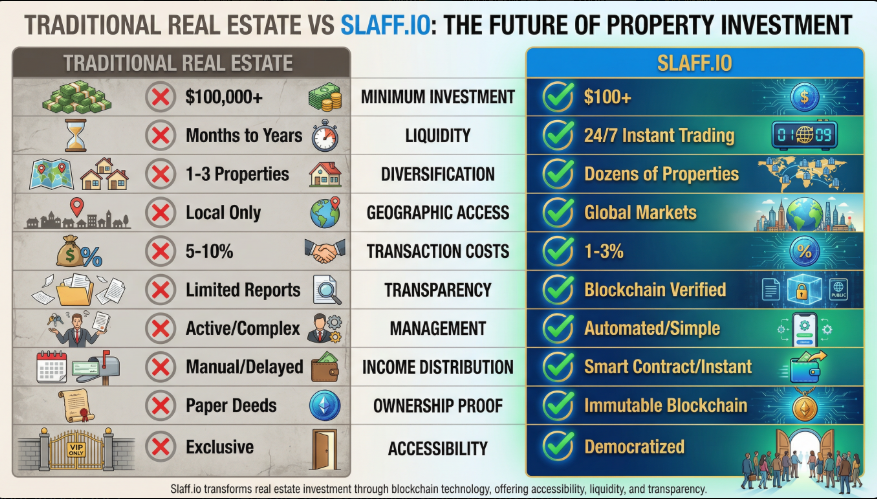
This is not a close competition where each approach has different strengths and weaknesses. Tokenized real estate through Slaff.io is categorically superior across every dimension that matters to investors. The only advantages of traditional real estate—familiarity, established legal frameworks, and the tangibility of physical property ownership—are rapidly being overtaken by the overwhelming benefits of tokenization.
Why Traditional Real Estate Investors Should Consider Slaff.io
Even if you are an experienced traditional real estate investor with substantial holdings, Slaff.io offers compelling reasons to allocate at least a portion of your real estate portfolio to tokenized assets.
Liquidity for Rebalancing
Traditional real estate portfolios become static because the cost and time required to sell properties and buy new ones is prohibitive. Tokenized real estate allows you to rebalance your portfolio efficiently, selling tokens in overweighted property types or markets and purchasing tokens in underweighted areas. This flexibility allows your portfolio to adapt to changing market conditions and your evolving investment thesis.
Geographic Diversification Beyond Your Local Market
Even successful local real estate investors face geographic concentration risk. Adding tokenized real estate in different markets provides diversification that reduces the impact of local economic downturns or market-specific challenges. You can maintain your local properties while gaining exposure to growth in other regions or countries.
Access to Property Types You Cannot Access Locally
Your local market may not offer certain property types—perhaps there are no industrial warehouses, vacation properties, or large commercial buildings available for investment at reasonable prices. Tokenized real estate provides access to these property types in markets where they are abundant, allowing you to build a more diversified portfolio across property categories.
Reduced Management Burden
Even with property managers, traditional real estate requires ongoing oversight and decision-making. Adding tokenized real estate to your portfolio provides real estate exposure without adding to your management burden. You can increase your real estate allocation without increasing your time commitment.
Lower Capital Commitment for Experimentation
If you want to test investing in a new property type or market, traditional real estate requires committing $100,000+ to purchase a property. Tokenized real estate allows you to experiment with $1,000 or $10,000, gaining exposure and learning about the new investment without risking substantial capital. If the investment performs well, you can increase your allocation. If it underperforms, your loss is limited.
Why New Investors Should Start with Slaff.io
For investors new to real estate, Slaff.io offers an ideal entry point that traditional real estate cannot match.
Learn Without Risking Substantial Capital
Real estate investment involves a learning curve—understanding property valuation, rental market dynamics, operating expenses, and market cycles. With traditional real estate, this learning happens with $100,000+ at risk. With Slaff.io, you can learn with $100 or $1,000 at risk, gaining experience and knowledge before committing larger amounts.
Build a Portfolio Gradually
Rather than saving for years to accumulate $100,000 for a single property purchase, you can begin building a real estate portfolio immediately with modest amounts. Invest $500 or $1,000 monthly, gradually accumulating a diversified portfolio over time. This dollar-cost averaging approach reduces timing risk and allows you to benefit from market fluctuations.
Professional Management from Day One
New investors lack the expertise to effectively select and manage properties. Slaff.io provides professional property selection and management from day one, allowing you to benefit from experienced real estate professionals' expertise without needing to develop that expertise yourself.
No Debt Required
Traditional real estate investment often requires taking on substantial debt through mortgages. This leverage amplifies both gains and losses, and creates the risk of foreclosure if you cannot make mortgage payments. Tokenized real estate requires no debt—you invest only the capital you have, eliminating leverage risk and the stress of mortgage obligations.
Flexibility to Exit
New investors may be uncertain about their long-term commitment to real estate investment. Traditional real estate locks you in for years—once you purchase a property, exiting requires months and substantial transaction costs. Tokenized real estate allows you to exit quickly if you decide real estate is not the right investment for you, or if your financial circumstances change.
The Future is Tokenized: Why This Transition is Inevitable
The comparison between traditional and tokenized real estate is not merely an academic exercise—it reveals a fundamental truth about the future of real estate investment. When one approach is superior across every relevant dimension, the transition from old to new is not a matter of "if" but "when."
History provides clear precedent. When automobiles proved superior to horse-drawn carriages across every dimension—speed, reliability, cost, convenience—the transition was inevitable despite initial resistance. When digital photography proved superior to film across every dimension—cost, convenience, instant feedback, storage—the transition was inevitable despite film's long history. When streaming proved superior to physical media across every dimension—convenience, selection, cost, accessibility—the transition was inevitable despite decades of DVD and Blu-ray dominance.
Tokenized real estate is following the same trajectory. It is not a marginal improvement—it is a 10x to 1,000x improvement across multiple dimensions. The minimum investment is 1,000x lower. Liquidity is 100x faster. Transaction costs are 50% to 80% lower. Diversification is 10x better. Transparency is absolute rather than limited. Management burden is eliminated rather than merely reduced.
When improvements are this dramatic, adoption accelerates rapidly once the technology matures and regulatory frameworks develop. We are at that inflection point now. The technology is proven—blockchain has operated reliably for over a decade. The regulatory frameworks are developing—multiple jurisdictions have implemented clear rules for tokenized securities. The infrastructure is being built—platforms like Slaff.io are creating user-friendly access to tokenized real estate.
The question for investors is not whether tokenized real estate will replace traditional real estate investment—it will. The question is whether you will be an early adopter who benefits from the transition, or a late adopter who watches others build wealth through tokenized real estate while you remain locked into traditional approaches.
Conclusion: The Choice is Clear
Real estate investment has been one of the most reliable paths to wealth building throughout human history. The challenge has always been that this wealth-building opportunity was accessible only to those with substantial capital, local market expertise, and the willingness to accept illiquidity and active management burdens.
Slaff.io has eliminated these barriers through blockchain technology and asset tokenization, creating a real estate investment approach that is superior to traditional methods across every dimension. Lower minimums, instant liquidity, better diversification, global access, lower costs, complete transparency, zero management burden, automated income distribution, immutable ownership records, and universal accessibility—Slaff.io delivers improvements in every area that matters to investors.
This is not incremental improvement—it is transformative innovation that democratizes real estate investment and makes institutional-grade property portfolios accessible to everyone. Whether you are an experienced traditional real estate investor seeking to enhance your portfolio with tokenized assets, or a new investor taking your first steps into real estate investment, Slaff.io offers a superior approach that delivers better outcomes with lower barriers and greater flexibility.
The future of real estate investment is tokenized, transparent, liquid, and accessible. That future is available today at Slaff.io. The only question is whether you will embrace it now or wait until everyone else has already captured the early-adopter advantages.
Priporočene vsebine / Recommended Reading
- Beyond Bitcoin: Complete Visual Guide to Blockchain Investing 2026
- How to Integrate AI into Your Business Strategy in 2026 Guide
- How to Optimize robots.txt for AI Search Engines in 2026 Guide
- Real Estate Investment 2026: Traditional Ownership vs Tokenization
- Beyond Bitcoin: Complete Visual Guide to Blockchain Investing 2026
Frequently Asked Questions (FAQ)
1. Can I still invest in traditional real estate if I also invest in Slaff.io?
Absolutely. Slaff.io is not an all-or-nothing proposition—it is a complement to traditional real estate investment, not a replacement. Many investors maintain traditional real estate holdings (perhaps their primary residence or local investment properties they manage directly) while also allocating a portion of their portfolio to tokenized real estate through Slaff.io. This hybrid approach allows you to maintain the benefits of traditional real estate (such as direct control over specific properties) while gaining the advantages of tokenization (liquidity, diversification, lower minimums, global access). The optimal allocation depends on your individual circumstances, goals, and preferences. Some investors may choose to gradually transition from traditional to tokenized real estate over time, while others may maintain a permanent allocation to both approaches.
2. Is tokenized real estate as "real" as traditional real estate ownership?
Yes, tokenized real estate represents genuine ownership in real physical properties—the same buildings, land, and rental income that traditional real estate provides. The only difference is how that ownership is recorded and transferred. Traditional real estate ownership is recorded through paper deeds and government registries; tokenized real estate ownership is recorded through digital tokens on a blockchain. Both represent legal ownership rights to the underlying property, including rights to rental income, property appreciation, and voting on major decisions. In fact, blockchain-based ownership may be more "real" in the sense that it provides mathematically certain, immutable proof of ownership that cannot be disputed, lost, or manipulated—advantages that traditional paper-based ownership cannot match. The properties in Slaff.io's portfolio are real buildings in real locations generating real rental income, just like any traditional real estate investment.
3. What happens to my tokenized real estate if Slaff.io ceases operations?
Your ownership of tokenized real estate is recorded on the blockchain, which exists independently of Slaff.io's platform. Even if Slaff.io were to cease operations, your tokens and the blockchain record of your ownership would persist. The underlying properties would still exist and still generate rental income. However, the practical management of those properties and the distribution of income would need to be handled by a successor entity or through the legal structures that hold the properties. Most tokenized real estate offerings include provisions for what happens if the platform ceases operations—typically, a successor manager is appointed, or the properties are sold and proceeds distributed to token holders. This is similar to traditional real estate funds, where if the fund manager ceases operations, a successor is appointed or the fund is wound down. The key advantage of blockchain-based ownership is that your ownership rights are permanently recorded and cannot be erased, providing strong legal protection even if the platform changes.
4. How do taxes work for tokenized real estate compared to traditional real estate?
The tax treatment of tokenized real estate is generally similar to traditional real estate investment, though specific rules vary by jurisdiction and continue to evolve as regulations catch up with tokenization technology. Rental income distributions from tokenized real estate are typically taxed as ordinary income, just like rental income from traditional properties. Capital gains from selling tokens are typically taxed as capital gains, with the rate depending on your holding period (short-term vs. long-term), just like selling traditional properties or REIT shares. Some tokenized real estate structures may allow for depreciation deductions or other tax benefits similar to traditional real estate. However, the tax treatment of tokenized assets is still developing, and regulations may change. It is essential to consult with a tax professional familiar with both real estate and tokenized asset taxation in your jurisdiction to understand your specific tax obligations. Reputable platforms like Slaff.io provide tax documentation to help investors report their income and gains accurately.
5. Is tokenized real estate more risky than traditional real estate?
Tokenized real estate carries the same fundamental real estate risks as traditional property investment—property values can decline, rental income can decrease, tenants can default, and local markets can experience downturns. These property-specific and market risks are inherent in real estate regardless of how ownership is recorded. However, tokenized real estate through platforms like Slaff.io may actually be less risky than traditional real estate in several ways. First, the low minimum investment and easy diversification allow you to spread risk across many properties rather than concentrating in one or two, reducing property-specific risk. Second, the liquidity of tokenized real estate allows you to exit positions if you believe risks are increasing, while traditional real estate locks you in for months or years. Third, the transparency of blockchain-based platforms allows you to monitor property performance in real-time and verify all financial data, reducing information risk. Fourth, professional management by experienced real estate teams may reduce operational risks compared to individual investors managing properties themselves. Tokenized real estate does introduce some additional risks—technology risk (blockchain and smart contract vulnerabilities), regulatory risk (evolving rules for tokenized securities), and platform risk (dependence on the platform's continued operation). However, for most investors, the risk-reduction benefits of diversification, liquidity, and transparency outweigh these additional technology and regulatory risks.
IMPORTANT DISCLAIMER
Not Financial Advice: This article is provided for informational and educational purposes only and does not constitute financial, investment, legal, or tax advice. The content is based on publicly available information and industry research and should not be relied upon as the sole basis for making investment decisions.
Investment Risks: All investments carry risk, including the potential loss of principal. Tokenized real estate investments involve specific risks including but not limited to: market volatility, liquidity risk, regulatory uncertainty, technology risks, property-specific risks, and the potential for total loss of investment. Past performance is not indicative of future results.
Consult Professionals: Before making any investment decision, you should consult with qualified financial, legal, and tax advisors who understand your specific circumstances, risk tolerance, and investment objectives. This is particularly important for tokenized assets and blockchain-based investments, which may have complex legal and tax implications.
No Guarantees: No representation or warranty is made concerning the accuracy, completeness, or timeliness of the information provided. Market conditions, regulations, and technology are subject to change. Projected returns, market size estimates, and growth forecasts are based on third-party research and should not be considered guaranteed outcomes.
Platform-Specific Information: References to Slaff.io or any other platform are for illustrative purposes. Investors should conduct their own due diligence on any platform before investing, including reviewing offering documents, understanding fee structures, and verifying regulatory compliance in their jurisdiction.
Regulatory Compliance: Tokenized securities may be subject to securities regulations in your jurisdiction. Ensure you understand and comply with all applicable laws, including investor accreditation requirements, if any.
Independent Research: This article should be considered one source of information among many. Conduct thorough independent research before making investment decisions.
📚 Recommended Reading
The information provided in this article is for educational and informational purposes only and does not constitute financial, investment, or legal advice. Real estate investments involve risk, including the possible loss of principal. Past performance is not indicative of future results. Always conduct your own due diligence and consult with a qualified financial advisor before making any investment decisions. Investra.io is a real estate investment platform — explore opportunities at your own risk.
📚 Priporočene vsebine / Recommended Reading
Razširite svoje znanje z naslednjimi strokovnimi vsebinami:
- 🌐 Siniša Dagary — Business Consultant & Sales Leadership Expert
- 📖 Slovenian Real Estate Market 2026: A Complete Analysis & Forecast
Strokovne vsebine: sinisadagary.com — Poslovni svetovalec & Sales Leadership trener