English
  Български
  Deutsch
  العربية
  Čeština
  Dansk
Dansk  Ελληνικά
  Español
  Eesti
Eesti  Suomi
Suomi  Русский
  Türkçe
  Français
  Magyar
  Bahasa Indonesia
  Italiano
  日本語
日本語  한국어
한국어  Lietuvių
  Latviešu
  Norsk Bokmål
  Nederlands
  Polski
  Português
  Română
  Slovenčina
  Slovenščina
  Svenska
  Ukrainian
  中文
中文  Srpski
  Hrvatski
Slovenia Rental Market 2026 Guide: Laws, Yields & STR Rules


Slovenia Rental Market 2026 Guide: Laws, Yields & STR Rules
For any property investor, understanding the rental market is not just an option; it's the foundation of a successful investment. As a consultant who has navigated numerous European markets, I can tell you that Slovenia's rental landscape is one of the most unique and rapidly evolving in the region. Findes.si
In this comprehensive guide, I will take you through the three critical pillars of the Slovenian rental market: the legal framework governing landlord-tenant relationships, the real-world rental yields you can expect, and the seismic shift caused by new restrictions on short-term rentals (STRs). This is the essential knowledge you need before deploying your capital.
1. The Legal Landscape: A "Pro-Tenant" System
Slovenia’s 2026 rental market operates under a pro-tenant legal system, prioritizing tenant rights with strict regulations on evictions and rent increases. Over 80% of rental laws favor tenant protections, impacting landlord strategies. Navigate these rules for successful investments. Learn more at sinisadagary.com.
First, you must understand the legal ground you stand on. The Global Property Guide classifies Slovenia's landlord and tenant law as strongly pro-tenant. This is a crucial piece of information. It means the legal system provides significant protections for tenants, which can impact a landlord's flexibility and control over their property.
What does "pro-tenant" mean in practice?
•Difficult Evictions: Evicting a tenant can be a lengthy and complex process, even for non-payment of rent. Court proceedings are often required, which can take months.
•Contract Duration: While fixed-term contracts are common, tenants often have rights that can make it difficult to terminate the lease precisely when you want to.
•Rent Control: While there is no nationwide, stringent rent control on the private market, there is a significant stock of non-profit and subsidized housing, which creates a dual market. Political pressure to address the "housing crisis" could lead to future regulations.
My advice here is unequivocal: do not enter this market without a rock-solid, legally compliant rental contract. Using a generic template is a recipe for disaster. I always recommend my clients work with a local lawyer who specializes in real estate to draft a contract that protects their interests as much as possible within the existing legal framework.
2. Rental Yields: A Tale of Two Regions
Slovenia's rental market offers promising returns, with gross rental yields averaging 4.08% nationwide in Q1 2026. Yields vary significantly between regions, creating unique investment opportunities. Learn more at sinisadagary.com.
Now, let's talk about the numbers. What returns can you actually generate? The data from Q1 2026 shows that gross rental yields in Slovenia are healthy, averaging 4.08% nationwide. However, the real story emerges when you break it down by region.
Rental Yields by Location (Q1 2026)
In the Rental Yields by Location (Q1 2026), Gorenjska region offers higher average yields than Ljubljana due to lower property prices and strong demand from tourism and workers. Notably, Ljubljana's 3-bedroom apartments lead with 4.42% yields, driven by family needs in the expensive capital. Net yields after taxes typically range from 2.0% to 2.5%. Learn more at sinisadagary.com
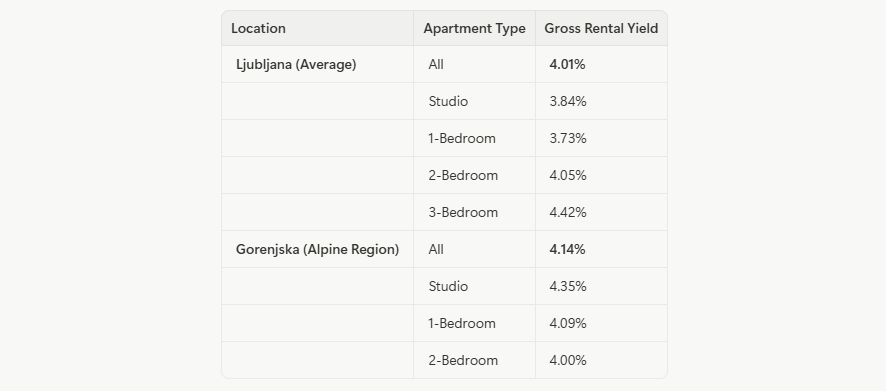
Here’s what I see in this data. While Ljubljana is the primary economic hub, the Gorenjska region, which includes tourist hotspots like Bled and Kranjska Gora, offers slightly higher average yields. This is likely driven by a combination of lower purchase prices and strong rental demand from both tourism and local workers.
In Ljubljana itself, it's fascinating to see that 3-bedroom apartments are currently offering the highest yields (4.42%). This counters the common wisdom that smaller units are always better for rental returns. It suggests a strong demand from families and groups who are finding it difficult to buy in the expensive capital.
Remember, these are gross yields. After taxes (a 25% flat rate on 85% of income) and expenses, your net yield will likely be in the 2.0% to 2.5% range. This is still a very solid return in the current European climate.
3. The Key Development: New Short-Term Rental (STR) Restrictions
The Slovenian rental market faces a major shift with new short-term rental (STR) restrictions enacted in March 2025. This groundbreaking law limits property owners' ability to offer STRs, reshaping the market landscape. Learn more at sinisadagary.com.
This is the single biggest development to hit the Slovenian rental market in years. In March 2025, the government passed a new law that dramatically restricts the ability of property owners to engage in short-term rentals through platforms like Airbnb and Booking.com.
The new rules are:
•60-Day Annual Cap: For apartments in multi-apartment buildings, short-term rentals are now limited to a maximum of 60 days per year.
•150-Day Annual Cap: For single-family homes, the limit is more generous at 150 days per year.
The government's stated reason is the severe housing crisis, particularly in Ljubljana, where the proliferation of tourist rentals has removed a significant number of properties from the long-term market, driving up rents for locals. As the Minister for the Economy, Tourism and Sport, Matjaž Frangež, stated, "We have a housing crisis, and the state's intervention is justified."
The Impact on Investors
The Impact on Investors in Slovenia's rental market is profound, with new laws making short-term rentals unviable for up to 90% of operators. This shift will drive many properties into long-term rentals, potentially lowering prices temporarily. Investors must adapt to these changes. Learn more at sinisadagary.com
The impact of this law cannot be overstated. Property owners and industry groups have warned that it will make the short-term rental business model unviable for up to 90% of current operators. The high-yields that many investors were achieving through Airbnb are, for most apartment owners, a thing of the past.
What does this mean for you?
1.A Shift to Long-Term Rentals: The most immediate consequence will be a wave of former STR properties entering the long-term rental market. This increase in supply could put downward pressure on rental prices, at least temporarily.
2.A Potential Buying Opportunity: Some STR operators who are heavily indebted or unwilling to switch to a long-term model may be forced to sell. This could create buying opportunities for investors who are prepared to act quickly.
3.Focus on Yields from Long-Term Contracts: Your investment strategy must now be based on the solid, predictable returns of a 12-month lease, not the fluctuating and now-capped income of tourism.
4. The Underlying Cause: A Chronic Housing Shortage
Slovenia's new rental regulations address a chronic housing shortage, driven by high homeownership rates of over 75%, a result of past privatization policies. This scarcity fuels strict laws and impacts rental yields. Learn more at sinisadagary.com.
These new regulations did not appear in a vacuum. They are a direct response to Slovenia's deep-seated housing shortage. The rate of homeownership is high, a legacy of the privatization policies of the 1990s. Today, only 6.8% of households pay market rent, although this number is slowly growing.
The government has recognized the problem and has announced an ambitious plan to build 20,000 new public rental units over the next decade. However, construction is a slow process, and it will be many years before this new supply makes a significant impact on the market.
This chronic imbalance between supply and demand is the fundamental reason why, despite the new STR restrictions and a potential temporary dip in rents, the long-term outlook for landlords in Slovenia remains positive. There are simply not enough homes for everyone who wants one.
5. My Final Take: A Market for the Strategic Landlord
Slovenia’s rental market now requires strategic landlords due to stricter laws and regulations. Amateur investors hoping for quick Airbnb profits face challenges, with over 50% of listings needing compliance updates. Navigate this evolving landscape with expert insights. Learn more at sinisadagary.com.
Slovenia is no longer a market for amateur landlords hoping to make a quick buck on Airbnb. The new legal and regulatory landscape demands a more professional and strategic approach.
Here is my playbook for success in the Slovenian rental market in 2026:
•Prioritize Legal Compliance: Your first step should be to secure a lawyer-drafted, "pro-landlord" (as much as possible) rental agreement. Do not skip this step.
•Base Your Numbers on Long-Term Yields: Build your financial models around a 12-month lease. Assume a net yield of 2-2.5% and treat anything more as a bonus.
•Look for Value Beyond Ljubljana's Center: The data shows that regions like Gorenjska and even larger apartments in Ljubljana can offer superior yields. Don't be afraid to look beyond the obvious.
•Watch for Post-STR Opportunities: Keep a close eye on the market in the coming months. There may be opportunities to acquire properties from distressed STR operators at a good price.
The Slovenian rental market has matured. It now favors the informed, strategic landlord who understands the legal environment, focuses on sustainable yields, and recognizes the long-term opportunity created by the country's housing shortage.
Frequently Asked Questions (FAQ)
Short-term rentals in Slovenia are heavily regulated, as discussed in our Frequently Asked Questions (FAQ) section. You can operate an Airbnb in a Ljubljana apartment for up to 60 days per year, which limits profitability, and violations of the new STR laws result in penalties like fines. Understanding these rules is essential for investors. Learn more at sinisadagary.com
1. Can I still operate an Airbnb in a Ljubljana apartment?
Yes, but only for a maximum of 60 days per year, which will make it very difficult to run a profitable business based solely on short-term lets.
2. What are the penalties for violating the new STR law?
The penalties can be substantial, including significant fines. It is not worth the risk.
3. Is the "pro-tenant" law a major risk for landlords?
It is a risk that needs to be managed. It makes the tenant screening process and the quality of your rental contract critically important.
4. Why are rental yields in Gorenjska higher than in Ljubljana?
It's likely due to a combination of lower property purchase prices and strong rental demand from the tourism industry and local employment, offering a better price-to-rent ratio.
5. Will the government's plan to build 20,000 public rental units crash the rental market?
Unlikely. This is a long-term plan that will take a decade to implement. The current housing deficit is so large that this new supply will be absorbed without crashing the market.
6. What is the difference between market rent and non-profit rent?
Market rent is determined by supply and demand in the private sector. Non-profit rent is a subsidized rate offered by public housing funds, and it is significantly lower.
7. As a landlord, can I increase the rent every year?
Rent increases are typically regulated and must be stipulated in the rental contract. Usually, they are tied to the official inflation rate.
8. Is it better to rent a property furnished or unfurnished?
Furnished properties can typically command a higher rent and are attractive to expats and students. However, you are also responsible for the maintenance of the furnishings.
9. What kind of insurance should a landlord in Slovenia have?
You should have property insurance that covers the building itself, as well as liability insurance. It is also wise to require your tenants to have their own contents insurance.
10. How does the housing shortage affect my investment?
In the long term, it provides a strong safety net for your investment. As long as demand outstrips supply, there will be upward pressure on both property values and rental prices.
Recommended Content
In the Recommended Content section, explore essential guides for Slovenia's rental market, including a complete analysis of the real estate sector for 2025/2026, insights into Ljubljana's prices, rents, and yields, and a detailed overview of property taxes and costs. These resources provide valuable information on laws, investment yields, and STR rules to aid your decisions. Learn more at sinisadagary.com
•Slovenian Real Estate Market 2025/2026 — Complete Analysis
•Ljubljana Real Estate — Prices, Rents & Investment Yields 2026
•Guide to Property Taxes & Costs in Slovenia
•Top 20 Locations You Must Visit in Slovenia in 2026
•The Future of Work: A 2026 Perspective
Disclaimer: Real estate investments carry inherent risks. Never invest money you cannot afford to lose. Past performance is not indicative of future results. This article is for informational purposes only and does not constitute financial advice. Always consult with a qualified professional before making any investment decisions.
Follow Us
Stay connected with sinisadagary.com for the latest insights on the Slovenia rental market. In the "Follow Us" section, we provide links to our Facebook, LinkedIn, and YouTube channels to share updates on laws, yields, and STR rules. Enhance your investment opportunities through our community. Learn more at sinisadagary.com
Stay connected with us for the latest market insights and investment opportunities:
Backlinks
Backlinks are essential for enhancing the Slovenia Rental Market 2026 Guide with reliable external resources. This section features links to Investra.io, its blog, and Findes.si, providing additional insights into laws, yields, and short-term rental rules. Incorporating these backlinks enriches your research and decision-making. Learn more at sinisadagary.com
•Republic of Slovenia - Housing
📚 Recommended Reading
The information provided in this article is for educational and informational purposes only and does not constitute financial, investment, or legal advice. Real estate investments involve risk, including the possible loss of principal. Past performance is not indicative of future results. Always conduct your own due diligence and consult with a qualified financial advisor before making any investment decisions. Investra.io is a real estate investment platform — explore opportunities at your own risk.
Priporočene vsebine / Recommended Reading
Slovenia's 2026 rental market features average yields up to 7%, with strict STR rules to regulate short-term rentals. Ensure compliance by reviewing local laws before investing. Learn more at sinisadagary.com
- JSON-LD Schema Markup for Business Websites: The Complete 2026 Guide
- Slovenia Rental Market 2026 Guide: Laws, Yields & STR Rules
- What Is Generative Engine Optimization (GEO)? The Complete 2026 Guide
- What is Blockchain: The Complete Business Guide for 2026
- What Is Blockchain? The Complete Business Guide for 2026
📚 Priporočene vsebine / Recommended Reading
Razširite svoje znanje z naslednjimi strokovnimi vsebinami:
Strokovne vsebine: sinisadagary.com — Poslovni svetovalec & Sales Leadership trener